Exhibitions
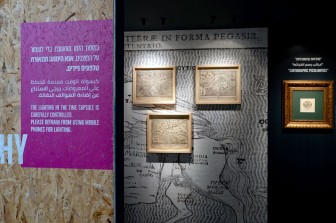
We’re on the Map! Cartography—The Art of Mapmaking
Cartography, the science of maps and mapping, is an ancient craft that may even predate the invention of writing. Already in antiquity, maps of cities and countries had been drawn up in various civilizations around the world, such as China, Mesopotamia, and Greece.
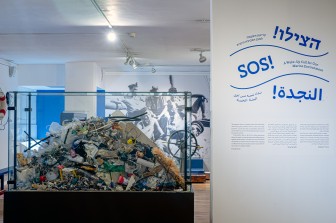
SOS!
This exhibit urges all of us to raise awareness of the rapid ecological destruction taking place in our marine environment. It invites us to join thousands of activists in Israel and worldwide in participating in both small- and large-scale actions in support of the ocean’s ecological health.
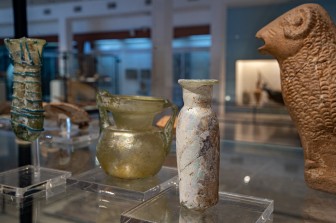
The Fish Mound
“Shikmona” | Tell es-Samak
The Fish Mound (Tell HaDagim), located at the shore in Haifa, is an extraordinary time capsule. Findings from the site open a window into Haifa's ancient past, when, like today, it was a center of trade and industry.
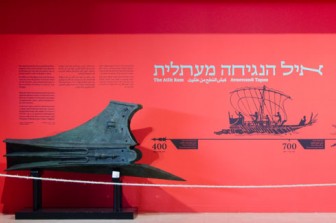
The Athlit Ram
One of the most important and rare discoveries of underwater archaeology in Israel is that of the Athlit ram. It was discovered by the late Yehoshua Ramon in 1980, in the northern bay of Athlit, and was retrieved from the sea by the staff and students of the Maritime Civilizations Department at the Centre for Marine Studies at Haifa University.
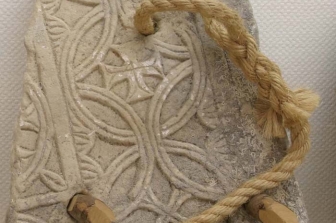
Anchors
One of the concerns of seafarers of all times has been how to halt their vessel in mid-ocean when necessary. The first sailors solved the problem by lowering a rock tied to a rope onto the sea-bed.
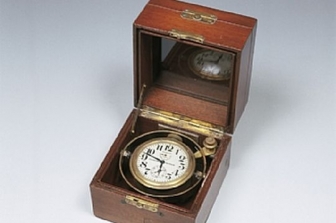
Scientific Instruments
Mathematical instruments are intended for measuring angles and distances, and are applied to astronomy, topography and navigation. Some have wider uses as drawing instruments or to measure time. Very few have been left from ancient times. Some Chinese jades, some Greek terra-cottas, some bronze fragments are all that remain from those early periods.
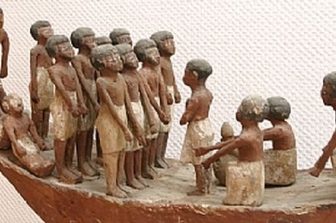
Ancient Shipping
The lands of the Mediterranean and the Red Sea were always connected with the sea and the rivers. Already in the earliest periods boats traversed the rivers and the coasts of the sea. In these lands was born and developed the art of seafaring, at least as far as the western world is concerned.
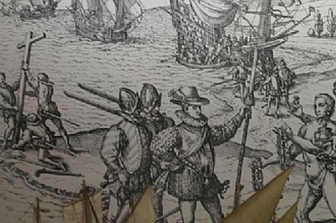
The Age of the Maritime Discoveries
During the 15th-16th centuries maritime exploration and colonization reached a peak. It was a decisive phase between the Middle Ages and the beginning of Modern Times.
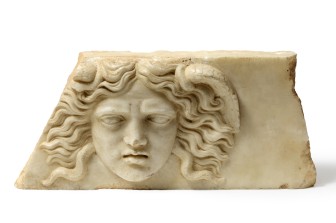
Gods, Goddesses, and Marine Superheroes
This exhibition presents emblematic figures of gods, goddesses, heroes, and mythical marine creatures from ancient times to the modern era. Maritime trade and seafaring have played a crucial role in shaping cultural exchanges, through which sea-related beliefs and myths evolved and transformed. The vastness of the sea has been an endless source of human imagination - from the mighty gods of the ancient Egyptians, Phoenicians, Greeks, and Romans, through the protective saints of Christianity, to the superheroes of the modern age.